Have you ever written a title and wondered whether words like and, the, of, or to should start with capital letters? You're not alone. Even experienced writers sometimes have trouble deciding which words to capitalize.
The good news is that title capitalization becomes easier once you understand a few basic rules.
Quick answer: In title case, articles (a, an, the), coordinating conjunctions (and, but, or), and certain prepositions (in, on, of, to) are usually written in lowercase when they appear in the middle of a title. However, the exact rules depend on the writing style you follow.
Let's look at some simple examples.
1. What Is Title Case?
Title case is a writing style in which you capitalize the important words in a title while leaving certain smaller words in lowercase.
For example:
Correct: How to Write a Good Story
Incorrect: How To Write A Good Story
Notice that How, Write, Good, and Story begin with capital letters. The connecting words to and a remain lowercase.
Title case is commonly used for book titles, blog posts, article headings, presentations, and academic papers.
2. Which Words Are Not Capitalized in a Title?
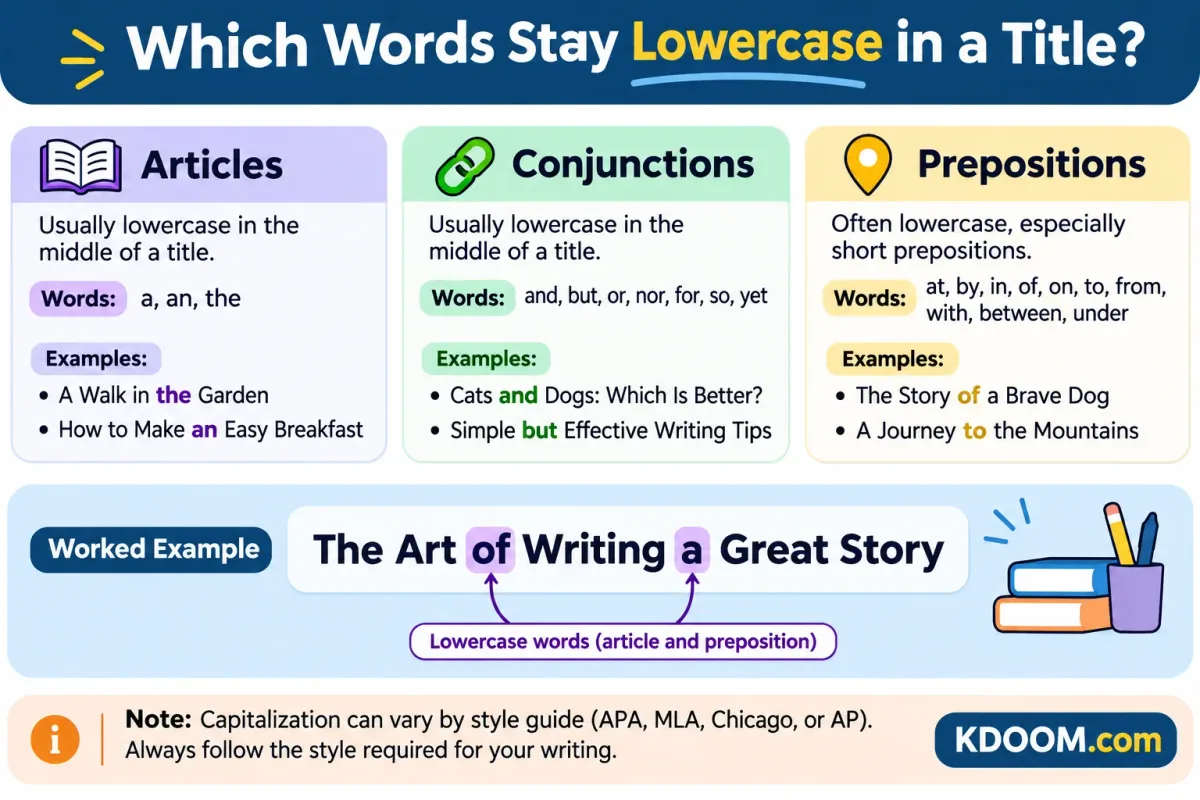
There are three main groups of words that often stay lowercase.
A. Articles: A, An, and The
Articles are short words used before nouns.
The three English articles are:
a
an
the
In most title-case styles, these words remain lowercase in the middle of a title.
Examples:
The Girl with a Red Umbrella
A Walk in the Garden
How to Make an Easy Breakfast
The Story of a Brave Little Dog
Notice that The and A are capitalized when they begin a title.
B. Coordinating Conjunctions
Conjunctions connect words, phrases, or ideas.
Common coordinating conjunctions include and, but, or, nor, for, so, and yet.
Many title-case styles keep these words lowercase when they appear in the middle.
Examples:
Cats and Dogs: Which Makes a Better Pet?
Simple but Effective Writing Tips
Tea or Coffee: Which Should You Choose?
Learning and Growing Together
However, not every conjunction follows the same rule. Words such as Because and Although are generally capitalized in title case.
C. Prepositions
Prepositions show relationships involving place, time, direction, or other connections.
Common examples include:
at, by, in, of, on, to, from, with, between, and under.
Here is where capitalization can become tricky.
Some styles keep many prepositions lowercase, while others capitalize longer prepositions.
For example:
Chicago style: A Walk with Friends
APA style: A Walk With Friends
Both are correct under their respective rules.
The important thing is to choose one style and follow it consistently.
3. Quick Reference: Words Usually Written in Lowercase
The following table uses common title-case conventions. It is not a universal rule for every writing style.
Word typeCommon wordsGeneral ruleArticlesa, an, theUsually lowercase in the middleCoordinating conjunctionsand, but, or, norUsually lowercase in the middleShort prepositionsat, by, in, of, on, toUsually lowercase when used as prepositionsLonger prepositionsfrom, with, between, throughDepends on the style guideVerbsis, are, be, was, haveCapitalizeNouns and adjectivesstory, beautiful, writingCapitalize
Remember: A word's job in the title matters. For example, up may be lowercase as a preposition but capitalized when it acts as an adverb in a phrase such as Wake Up.
4. When Should Small Words Be Capitalized?
Small words do not always stay lowercase.
Rule 1: Capitalize the First Word
The first word of a title is capitalized, even when it is an article or preposition.
Examples:
The Secret Garden
A Beautiful Morning
In Search of Happiness
Rule 2: Check the Last Word
Chicago, MLA, and AP styles generally capitalize the last word of a title, even when it is normally a minor word.
For example:
What Are You Looking For?
This Is What I Believe In
APA uses a different approach and does not automatically capitalize every final minor word.
Rule 3: Capitalize Important Words
Nouns, pronouns, verbs, adjectives, and adverbs are generally capitalized.
Examples:
Why Reading Makes You Smarter
The Best Ways to Learn English
She Is Ready for School
Notice that Is is capitalized because it is a verb. Its short length does not make it a minor word.
5. APA vs. MLA vs. Chicago vs. AP: What's the Difference?
Different style guides apply slightly different capitalization rules.
StyleGeneral capitalization ruleAPA 7Capitalize major words and words with four or more letters; lowercase articles and short minor wordsMLACapitalize major words; lowercase articles, prepositions, and coordinating conjunctionsChicago 18Capitalize major words and prepositions with five or more letters; lowercase shorter prepositionsAPCapitalize major words and prepositions or conjunctions with four or more letters
For example, consider the word with.
APA: With
MLA: with
Chicago: with
AP: With
Chicago changed its guidance in its 18th edition, published in 2024, and now capitalizes prepositions with five or more letters.
For formal assignments or professional publications, always check the required style guide.
6. Title Capitalization Examples
Let's compare some incorrectly capitalized titles with corrected versions using Chicago-style rules.
Incorrect titleCorrect titleHow To Write A Better EssayHow to Write a Better EssayThe Cat And The MoonThe Cat and the MoonA Guide To Healthy EatingA Guide to Healthy EatingThe Benefits Of Reading BooksThe Benefits of Reading BooksMy First Day At SchoolMy First Day at SchoolLearning English With Simple StoriesLearning English with Simple StoriesThe Art Of Making TeaThe Art of Making TeaWhat Is The Meaning Of Friendship?What Is the Meaning of Friendship?A Journey Through The MountainsA Journey Through the MountainsHow To Become A Better WriterHow to Become a Better Writer
These examples show why you shouldn't simply capitalize the first letter of every word.
7. How to Capitalize Any Title Automatically
Checking every word manually can take time, especially when you're writing several article headings or working with different writing styles.
You can use the free KDOOM Title Case Converter to make the process easier.
Here's how:
Open the Title Case Converter.
Type or paste your title.
Choose APA, Chicago, MLA, or another available style.
Review the converted title.
Copy the result and use it in your document.
The tool applies capitalization rules as you type. You should still check names, abbreviations, and unusual words before publishing.
8. Frequently Asked Questions
Is "the" capitalized in a title?
Usually, the is lowercase in the middle of a title, but it is capitalized at the beginning. For example: The Story of the Lost Key.
Is "and" capitalized in a title?
In common title-case styles, and is usually lowercase in the middle of a title. Example: Books and Stories for Children.
Should "of" be capitalized in a title?
Generally, no. Of is usually lowercase in the middle of a title. Example: The Power of Positive Thinking.
Is "with" capitalized in a title?
It depends on the style. APA and AP capitalize With, while MLA and Chicago generally use with when it functions as a preposition in the middle of a title.
Is "is" capitalized in a title?
Yes. Is is a verb, so it is capitalized in standard title case. Example: Why Reading Is Important.
Should every word in a title start with a capital letter?
No. In title case, some connecting words stay lowercase. Capitalizing every word is a different formatting choice and may not follow the style required for your writing.
Final Thoughts
You don't need to memorize hundreds of capitalization rules to write a good title.
Start with three simple ideas: capitalize important words, keep articles and certain connecting words lowercase, and follow the style required for your work.
When you're unsure, check the rule or use the KDOOM Title Case Converter to format your title quickly.
A clear, correctly formatted title makes your writing look more polished and easier to read.